

 Военное обозрение
 By Top War
In the colonial novel “Distant Tents” by Mary Margaret Kay, the main character is an Indian princess with blue eyes. She got them from her grandfather, a Russian officer of the Cossack troops who fled to India because of a duel and became a general of one of the North Indian rajas. This is not exactly a fantasy. Only to get to the Indian border, the Russian deserters had to make their way through Afghanistan, and to get to the Persian border, they had to cross the Kura, not the widest river…
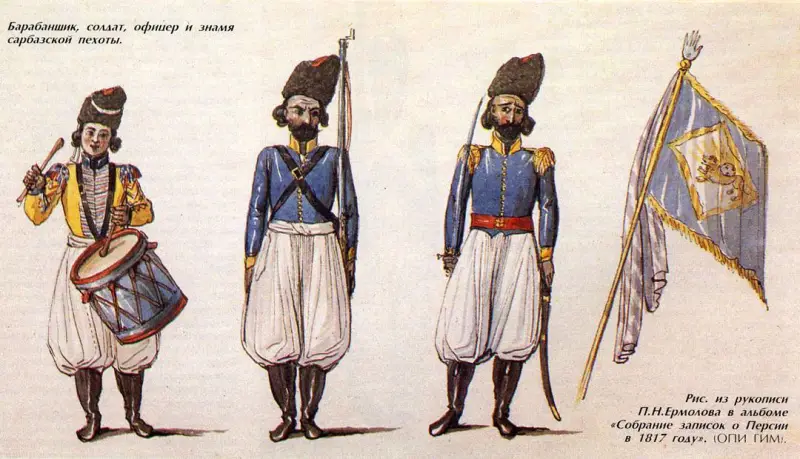
Sarbazy – Persian infantry. Ermolov painted from life…
The Persian army of the 19th century remained… Persian. It was impossible to instill in the Sarbazes the notions of European order and discipline, unlike the Turks or the Anglo-Indian sepoys, by any means – neither generous rewards nor cruel punishments. Perhaps the problem was that European officers were difficult to get into the service of the Persian shahs and in extremely limited quantities. But…
Russian Caucasian units were stationed as garrisons on the border with Persia. Service in the Caucasus was perceived not only as a punishment by officers (Lermontov will not let me lie), but also by soldiers, who did not like the garrison boredom, heavily mixed with barracks idiocy. Therefore, desertion to Persia was not just a frequent occurrence, but a mass one! On average, judging by the 17th Jaeger and 7th Carabinieri Regiments, up to 30 people deserted from the regiment per year. In the Persian Erivan Regiment, sometimes, according to the memoirs of the same Yermolov, no more than half of the personnel were Persians, the rest were Russian deserters who went “across the river”, where the Persian authorities did not offend the fugitives, allowing them to settle down, start a family… And they were glad to take them into service.
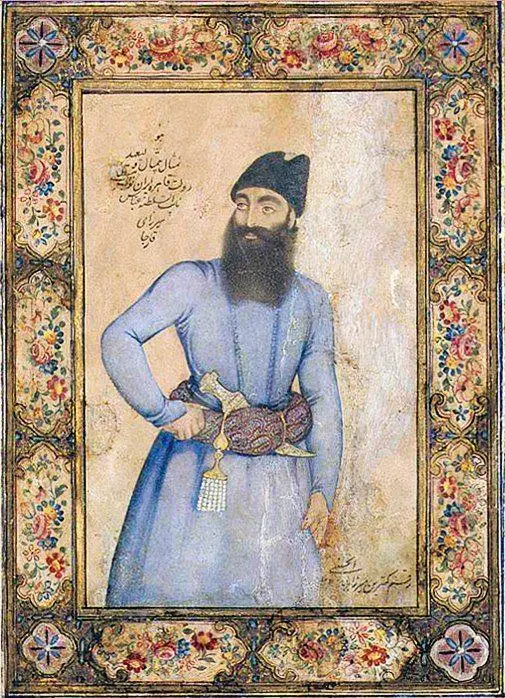
Abbas Mirza – the heir to the Persian throne in person…
The fact is that the heir to the Shah’s throne, Abbas Mirza, was a great lover of everything European. English and French instructors were hard to come by and cost a lot of money, but Russian deserters were always at hand. They began to Europeanize the Persian army. As early as November 4, 1807, Major General Nesvetayev reported:
“The officer of the 17th Jaeger Regiment, Lisenko, who fled to Persia, teaches the Persians regularity in Nakhichevan; why did Shah-zade (Abbas Mirza G. f. C.) ordered Hussein Khan of Erivan to persuade soldiers to escape and deliver deserters to him.”
In 1808, the British saw 30 Russian prisoners in Shiraz with the governor, under the command of their officer “Russ Khan”, who were training the sarbazes in the Russian manner…
READ FULL ARTICLE HERE… (en.topwar.ru)

Home | Caravan to Midnight (zutalk.com)