

 The Epoch Times
The Chinese regime recently claimed that extreme poverty had been eliminated countrywide, after removing the last remaining counties from a list of poor regions.
On Nov. 3, officials in one of China’s poorest provinces, Guizhou, announced that the last nine remaining counties had been removed from the nation’s list of poor regions. The list, drawn up in 2014, initially identified 832 counties as extremely poor.
China sets its own national standard of extreme poverty, based on a per capita income threshold of 4,000 yuan per year, or around $1.52 per day, and other factors such as access to basic health care and education. That compares with a threshold of $1.90 per day set by the World Bank to measure extreme poverty globally.
Poverty elimination by the end of the year was a key goal set by the regime in 2016. Chinese state media celebrated the “milestone,” but some netizens weren’t buying the claims.
One netizen posted: “Some places say they have eliminated poverty, but in fact, there is still poverty!”
Liang Xin (alias), a longtime charity-worker in Liangshan Yi Prefecture of southwest China’s Sichuan Province, told The Epoch Times that ethnic Yi people in the area have been left in even greater poverty than before as a result of the regime’s “targeted poverty alleviation” policies.
The Yi people are an ethnic minority in China, who mainly live in the mountainous southwestern regions of the country.

Housing Assistance Program Puts Yi People in Debt
According to Liang, the local Yi people rely on farming corn and potato, however, each household doesn’t own much arable land since the Liangshan region is mainly mountainous. Their crop yields give them just enough to eat, but doesn’t bring in additional income.
A housing assistance program introduced by the regime under its poverty elimination agency has instead caused locals to be saddled with debt, Liang said.
Under the program, a person is eligible for 40,000 yuan ($6,000) if they build a house or renovate their current house, according to Liang.
“But there’s a pre-condition: you must purchase building material from a government-designated company,” he said, adding that this increased the expense of construction to double the amount of the grant, 80,000 yuan ($12,000).
“That means you’ll be trapped in debt,” Liang said.
“If you just look out at the newly built Yi houses from the window of a driving vehicle, you’ll find the region more beautiful than before. However, you don’t know what their life is really like,” he added.
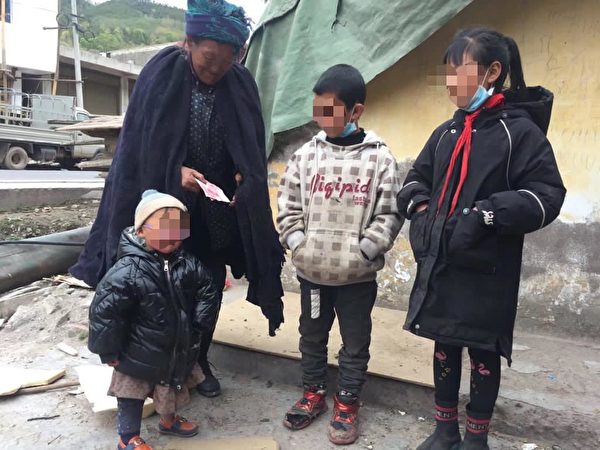
Liang said the Chinese Communist Party (CCP) has been destroying the Yi people’s culture and traditions through indoctrination and education, as it has towards other ethnic groups around China.
“The purpose of [the CCP] opening schools is to get the Yi people to accept the faith of atheism, and be willing subjects under communist rule,” he said.
Liang’s work has brought him in contact with Yi people living in abject poverty.
“Some children have not taken a bath from birth to seven or eight years old, nor have they seen toilet paper. Some people won’t have more than a few meals containing rice each year,” he said.
“Many elderly people cry when they see me giving money, thinking that I’m sent by the government. I reply that I was sent by God, not the government.”
Reuters and Hu Yuanzhen contributed to this article.