
 Военное обозрение
 By Topwar
Self-destruction theory
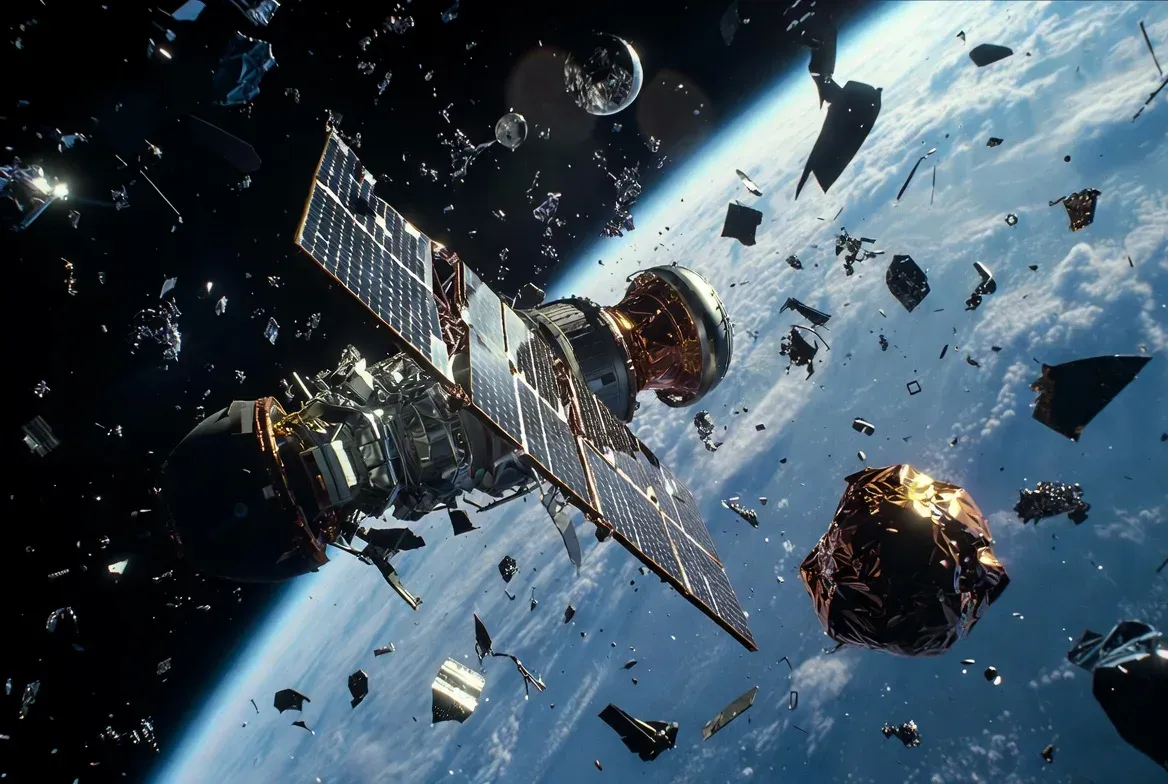
First, a few statistics. Near space currently contains at least 34,000 pieces of man-made debris over 10 cm in size, over one million pieces between 1 and 10 cm, and 120 million pieces up to 1 cm. These particles travel at hypersonic speeds and are capable of piercing any armor, not to mention the thin walls of spacecraft. On Earth, space debris is being inventoried as best they can. The total mass of debris in orbit has been calculated to be 8,000 tons, and 26,000 objects posing the greatest danger have been cataloged. Everyone is extremely careful to avoid even individual pieces in orbit. Half of the cataloged objects are intact components, decommissioned satellites, upper stages remaining in orbit, and waste from space operations. The other half are fragments of varying sizes resulting from collisions or explosions in orbit. The most polluted altitudes are considered to be those between 600 and 1200 km and the geostationary orbit at 35,800 km.
The idea that orbit would eventually become crowded has been discussed since the last century. In 1978, American scientists Donald Kessler and Burton Court-Palais proposed a theory according to which
At a certain critical density of objects in low-Earth orbit (altitudes of 200–2000 km), any collision begins to generate new debris, which, in turn, triggers further impacts. The process becomes self-sustaining: debris production exceeds natural removal by atmospheric braking, and the orbital environment becomes a “cosmic garbage dump,” making low-Earth orbit unsuitable for satellites, human missions, and even future launches for decades.
…
Read Full Article Here… | Topwar

Home | Caravan to Midnight (zutalk.com)




Be First to Comment