

 BBC News
 by Matt Spivey and Jamie Whitehead
Summary
-
Russia has vowed an “appropriate” response if Ukraine uses US long-range missiles to strike its territory.
-
The Kremlin warns Kyiv’s use of such missiles would mark an escalation in the conflict, hours after US officials say Joe Biden has given the green light
-
Biden tells leaders at the G20 summit in Brazil the US strongly supports Ukraine’s sovereignty and territorial integrity. Ukrainian President Volodymyr Zelensky has said “the missiles will speak for themselves”
-
The US will reportedly allow Ukraine to use the missiles to hold onto the small chunk of Russian territory it occupies in Kursk, reportingly making the decision after the Kremlin allowed North Korean troops to fight there
-
Meanwhile at least 10 people have been killed after a missile was shot down and fell on residential buildings in Odesa, following a weekend of widespread Russian attacks
23:15 18 November
Russia vows ‘appropriate response’ if Ukraine uses US long-range missiles – published at 23:15 18 November
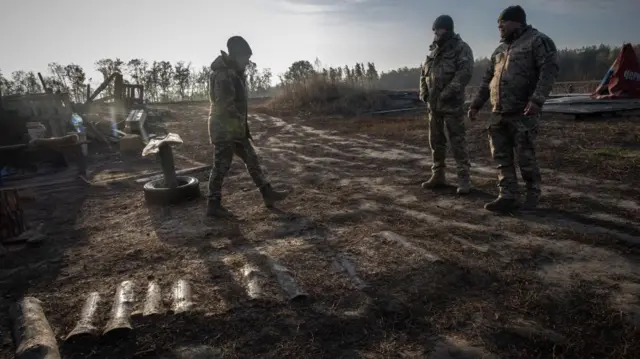 Image source,EPA
Before we go, we’ve rounded up some key details from our reporting today to give you a full picture of the conflict as it stands:
- Biden told world leaders at the G20 summit, in Brazil, that his administration “strongly supportsUkraine’s sovereignty and territorial integrity“, in the aftermath of his reported authorisation of Ukraine’s use of US long-range missiles
- Russia has promised an “appropriate” response if Ukraine does choose to use long-range missiles to strike its territory. United Russia MP Maria Butina said the US is “actually pushing the world to a very dangerous red line”
- Not all nations are on board with Biden: Hungary, Slovakia and Italy have voiced their opposition to the decision
- Other Western powers have yet to follow Washington’s lead. France and the UK have maintained that Storm Shadow missiles supplied by them can only be used on targets in Ukraine
- A Russian missile strike on an apartment building in the Ukrainian port city of Odesa killed at least 10 people and injured 47 others, according to local authorities. In Sumy, a city in Ukraine’s northwest, 11 people were killed and 63 injured in a Russian missile strike on a residential area
We’re now ending our live coverage, there is more on this story here and you can find more content from across the BBC in our post below.
23:00 18 November
Want more on this story? The BBC has you coveredpublished at 23:00 18 November
We’re going to be closing out live coverage soon, but there’s plenty more to read elsewhere for more insight on what’s happened today:
- Biden’s effort to help Ukraine: Reports say that US President Biden has allowed Ukraine to use long-range missiles to strike Russia, the BBC looked into how these missiles could affect the war
- Anger among Trump allies:For some analysis, we have this piece on how the outgoing president’s decision has stirred up incoming president Donald Trump’s allies
- North Korean troops in Ukraine: After the US and Ukraine revealed North Korean troops have been engaged in combat with Ukrainian soldiers, this is what we know about their involvement
- Will the UK follow the US? BBC’s defence correspondent Jonathan Beale unpacks what the UK could decide on Storm Shadow missiles provided by Britain
- Weapons being given to Ukraine: For a closer look, there’s this piece on what weapons are being supplied to Ukraine from different countries
- The scale of the conflict, in maps and graphics: The BBC’s Visual Journalism team has produced a piece on the recent significant events and situation in Ukraine
22:36 18 November
Chemical weapons watchdog finds evidence of banned substance in Ukrainian soilpublished at 22:36 18 November
Analysis conducted by an international chemical weapons watchdog has found banned CS riot gas in samples provided by Ukraine.
In a statement, the Hague-based Organisation for the Prohibition of Chemical Weapons says: “The results of the analyses of these samples conducted by two OPCW designated laboratories… indicate that both a grenade and a soil sample… contained the riot control agent known as CS”.
CS riot gas – commonly known as teargas – is banned for use in warfare under the Geneva Protocol, but is often deployed as a riot control measure.
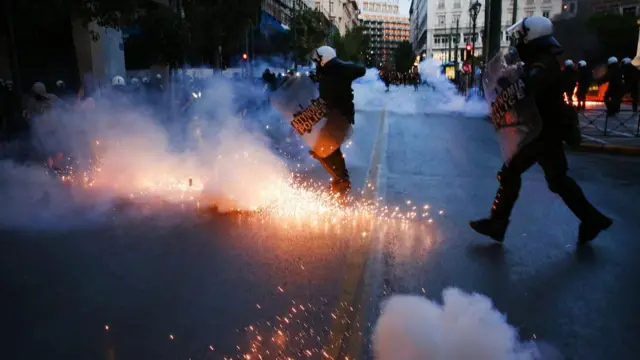 Image source,Reuters
Though it is banned in warfare, teargas is commonly deployed by police forces…
READ FULL ARTICLE HERE… (bbc.com)

Home | Caravan to Midnight (zutalk.com)